
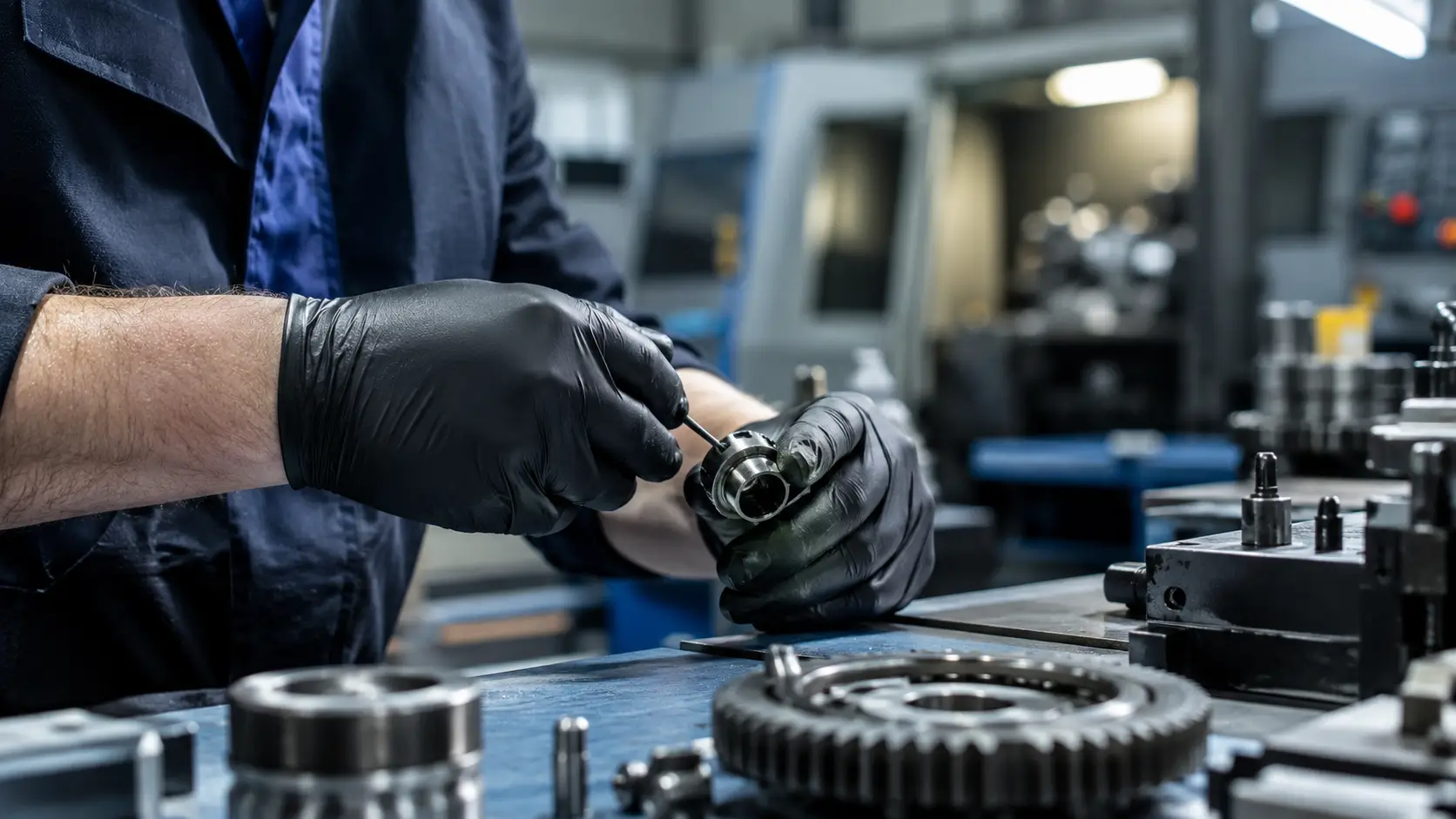
n the mechanical industry, the selection of work gloves depends on many factors – such as task, level of risk, environment, and specific operational conditions. The activities carried out in this sector are also diverse: assembly, maintenance, workshop operations, bodywork, handling of metal components require professional gloves with specific technical features.
In general, all mechanical industry gloves must protect the hands without limiting grip, tactile sensitivity, and precision of movement. Below we explain how to select them correctly.
Work gloves for the mechanical industry: key features to evaluate
Hand protection in mechanics requires a careful assessment of the type of work. In the presence of metal components, rough or sharp surfaces, tools, oils, greases, or fuels, the glove must offer an adequate level of protection and ensure good grip even during extended use.
Key features to consider include:
- Mechanical resistance: abrasion, wear, puncture, and contact with uneven surfaces are common risks in production departments, workshops, and maintenance activities.
- Chemical protection: especially when the operator works with lubricants, technical detergents, fuels, or other substances used in the industrial environment.
- Tactile sensitivity: plays a primary role since imprecise movement can reduce control over the piece or tool, increasing risks for the operator.
Gloves intended for mechanical work should ensure an optimal balance of protection, fit, elasticity, and comfort.
From a regulatory perspective, professional gloves must comply with EU Regulation 2016/425 regarding Personal Protective Equipment (PPE). Depending on the model and intended use, specific certifications may also be present, such as EN 388 for mechanical risks like abrasion, cut, tear, and puncture, and EN 374 for protection against chemicals and microorganisms.
Disposable nitrile gloves: practicality and sensitivity in operational activities
Disposable nitrile gloves are widely used in the mechanical industry because they provide practicality, good tactile sensitivity, and resistance to oils, greases, and many chemicals. They are particularly recommended when frequent glove changes, liquid protection, and precision handling are required.
Nitrile is a synthetic rubber free from natural latex. This makes it suitable even for operators sensitive to latex proteins.
For light to medium mechanical tasks, disposable nitrile gloves can be used for maintenance, inspection, handling of small components, tasks in contact with lubricants, or operations requiring good dexterity.
Reflexx 67 Black Nitrile Gloves
Reflexx 67 is a black, dust-free, disposable nitrile glove, 100% latex-free. The high thickness ensures good mechanical and puncture resistance, superior to most latex gloves. The micro-rough finish improves grip and tactile sensitivity, while the resistance to oils and greases makes it suitable for various professional uses.
It is ideal for industrial and professional activities requiring a robust and practical glove.
Reflexx Full Grip N85 Black Nitrile Gloves
Reflexx Full Grip N85 Black is a dust-free nitrile glove designed for more intensive applications. The 3D grip on palm and fingers ensures a stable hold even when wet or in contact with oil. Its high weight and thickness between 0.15 and 0.20 mm make it particularly suitable for industrial, mechanical, and automotive use.
It is recommended when durable mechanical gloves are required, able to withstand more demanding work without compromising sensitivity and control.
Reflexx N79 Plus Extra Long Nitrile Gloves
Reflexx N79 Plus is a dust-free nitrile glove with a long 30 cm cuff. This feature provides greater wrist and forearm protection, useful when the glove needs to cover more contact area or fit over clothing.
The high thickness ensures good mechanical resistance, while the micro-rough finish improves grip and sensitivity. It is a versatile model, also suitable for light industry and tasks requiring more extensive protection than a standard disposable glove.
Reusable gloves: durability and continuous protection
Reusable work gloves are recommended when a more robust barrier than disposable gloves is required. They are used in professional activities requiring continuous protection, longer durability, and good resistance to liquids, detergents, oils, greases, or chemicals.
Compared to disposable work gloves, they feature a thicker structure and are designed to maintain their performance even after repeated use, provided they are stored and sanitized according to the manufacturer’s instructions.
In the mechanical sector, they can be useful for maintenance, technical cleaning, light industry, and operations where wider protection is needed without necessarily moving to supported gloves. The anti-slip knurling present on several models improves grip, while the internal chlorination facilitates donning.
Reflexx 95 Nitrile Reusable Gloves
Reflexx 95 is a reusable nitrile glove with anti-slip knurling. The internal chlorination eases donning and helps reduce the risk of dermatitis.
It is a practical solution for professional activities requiring protection, grip, and continuous use and is classified as Category 3 PPE for protection against chemicals and microorganisms.
Reflexx 97 Nitrile Reusable Gloves
Reflexx 97 is a reusable nitrile glove with anti-slip knurling, Category 3 PPE for professional use. It is certified for protection against six chemicals and, thanks to its robust structure and extended protection, is an excellent choice when the activity requires a durable glove, suitable for contact with liquids and substances generally used in industrial environments.
Supported work gloves: grip, comfort, and abrasion resistance
Supported work gloves are among the most appreciated solutions for continuous mechanical operations. They are made of coated fabric, often with nitrile or polyurethane coating, and combine protection, comfort, safety, and good freedom of movement.
The seamless synthetic knit promotes fit and breathability, while the palm coating improves grip, protects against dirt, and increases abrasion resistance. These qualities make supported gloves ideal when handling components, tools, rough surfaces, or oily materials for extended periods.
In contexts where mechanical hand protection is a priority, this type of PPE offers several advantages over disposable gloves: greater durability, more stable grip, and better comfort during daily work.
Supported Nitrile Reflexx Gloves: N16 MS and N121
The supported glove with nitrile coating is particularly suitable when grip on oily or wet surfaces and good abrasion resistance are required. It is often chosen in bodywork, manufacturing, logistics, and environments with oil or grease presence.
Reflexx N16 MS is a supported polyamide/spandex glove with MicroSandy nitrile palm coating. The spandex increases elasticity and limits liquid penetration, while the MicroSandy coating provides good grip and oil-repellent properties. It is suitable for humid work environments or in the presence of oils and greases.
Reflexx N121 is a supported seamless synthetic knit glove with continuous yarn and external nitrile coating. It provides good dexterity, grip, and mechanical resistance but is not suitable for immersion in liquids. It is extremely comfortable to wear thanks to the ventilated back and fingers.
Nitrile, polyurethane, and technical materials: how to choose
The choice of material affects glove performance. In short:
- Nitrile is valued for resistance to oils, greases, and chemicals, as well as mechanical robustness. In supported gloves, the nitrile coating improves grip even on wet or oily surfaces.
- Polyurethane favors lightness, breathability, and tactile sensitivity. It is often used to produce gloves for assembly, quality control, and dry processing, where precision and dexterity are more important than liquid protection.
- High-performance technical materials, such as some cut-resistant fibers, are indicated when handling sheet metal, sharp edges, or metal components requires superior protection against cuts and abrasions.
How to choose the right glove according to the task
For maintenance and workshop tasks, high-thickness disposable nitrile gloves or reusable gloves provide protection and practicality, especially in the presence of oils and greases.
For automotive, bodywork, and heavy industry, durable mechanical gloves with high grip and good abrasion resistance are often preferred. In these cases, full grip nitrile gloves or supported gloves with MicroSandy coating can provide better control during handling.
For assembly and quality control, it is important to prioritize tactile sensitivity, fit, and lightness. When handling small components or performing precise movements, a glove that is too thick could limit manual dexterity.
During extended operations, supported or reusable gloves finally offer greater continuity of use and contribute to the operator’s comfort throughout the workday.
Reflexx: professional gloves for mechanical, industrial, and automotive sectors
Reflexx offers disposable, reusable, and supported professional gloves for various sectors, including mechanical, industrial, and automotive sectors. The range includes models in nitrile, latex, vinyl, neoprene, and other technical materials, selected according to the performance required in different applications.
Reflexx products comply with EU Regulation 2016/425 regarding Personal Protective Equipment and, depending on the model, may include specific certifications for mechanical risks, chemical protection, microorganisms, and food contact.
To choose the most suitable gloves for your activity, browse the Reflexx range dedicated to professionals or request support from our experts to find the most appropriate model based on task, risk, and sector.