
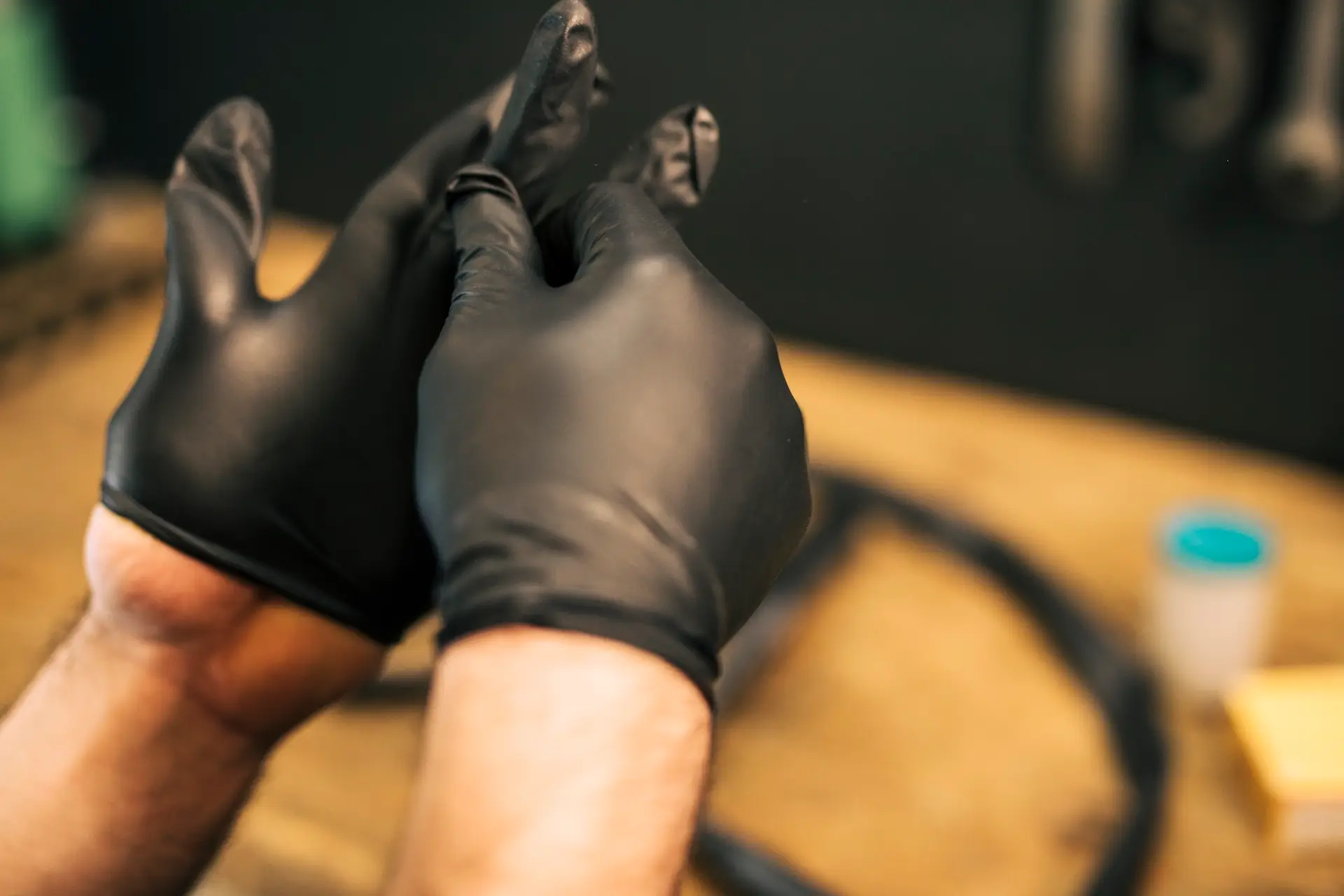
Hand protection in industrial environments is essential to ensure safety, operational continuity and work quality. In inherently complex sectors such as mechanics, automotive, maintenance and heavy industry, operators are daily exposed to mechanical hazards, chemical substances, oils, greases and abrasive surfaces.
For this reason, the choice of industrial gloves must be based not only on comfort, tactile sensitivity and fit, but also on certifications that objectively verify the effectiveness of the PPE.
At the same time, understanding the differences between latex, nitrile and vinyl gloves is essential to identify the most suitable solution for each specific task.
Why material selection is critical in industrial environments
In industrial settings, workers’ hands are exposed to multiple and often simultaneous risks: abrasion, cuts, punctures, contact with chemicals, oils, greases and fuels. This is compounded by frequent handling of hot, slippery or irregularly shaped surfaces.
Not all materials respond in the same way to these stresses: vinyl, latex and nitrile have very different technical properties in terms of resistance, elasticity, durability and protection. Choosing the wrong material significantly increases the risk of glove tearing, loss of grip, material degradation or inadequate chemical protection.
The selection of professional gloves therefore directly impacts safety, operational efficiency, comfort and production continuity.
Essential standards for hand protection in industry
Industrial activities require personal protective equipment that complies with strict standards, ensuring verifiable performance and real protection against workplace hazards. To properly assess a glove and its suitability, it is essential to understand the European regulations governing its design, testing and compliance.
EN 388: mechanical protection
EN 388 is the reference standard for evaluating glove resistance to abrasion, cutting, tearing and puncture. It is essential in sectors such as metalworking, automotive, industrial maintenance and workshops, where daily operations involve contact with irregular surfaces, sheet metal, tools and sharp components.
EN 374: chemical protection
EN 374 certifies glove resistance to permeation and penetration of chemical substances. It is indispensable when working with solvents, detergents, mineral oils, fuels and other aggressive agents commonly found in industrial and mechanical environments.
EU Regulation 2016/425 – PPE
All Reflexx industrial gloves comply with EU Regulation 2016/425, which defines the essential safety requirements for Personal Protective Equipment. This regulation ensures traceability, production quality and full regulatory compliance—fundamental requirements for reliable and continuous protection across industrial environments.
Latex, nitrile or vinyl? A brief comparative analysis of materials
Nitrile: the most resistant and versatile material for industrial gloves
Nitrile is considered the benchmark material for industrial gloves due to its exceptional combination of mechanical and chemical resistance.
Gloves made from nitrile provide superior protection against mineral oils, greases, hydrocarbons, gasoline, solvents, diluted acids and diluted bases, making them suitable even for the most demanding operations.
Its synthetic structure ensures controlled elasticity, high resistance to tearing and puncture, and excellent grip, even on wet or oily surfaces.
In addition, being latex-free, nitrile represents a safe alternative for operators with latex allergies.
Latex: elasticity and sensitivity, but with limitations
Latex is a natural material valued for its outstanding elasticity, which allows the glove to perfectly adapt to the hand and ensures very high tactile sensitivity. This makes it highly effective for precision tasks and prolonged activities requiring optimal comfort.
However, latex shows significant limitations in industrial environments: its chemical resistance is acceptable only against water-based substances, detergents and diluted acids, while it performs poorly in contact with oils, greases, solvents and fuels, as the material degrades rapidly.
The potential risk of allergic reactions must also be considered, although reduced today, it still exists in certain worker categories.
Overall, latex gloves are more suitable for laboratories, light industry and precision tasks, rather than mechanical or automotive environments.
Vinyl: cost-effective, but low industrial performance
Vinyl (PVC) is a rigid material made flexible through phthalates or other plasticizers. This composition makes it economically advantageous but limits its industrial performance.
Its chemical resistance is low and does not protect against oils, greases, solvents or fuels: vinyl tends to degrade and may develop micro-cracks or failures during use. Mechanically, it offers limited protection and is not suitable for tasks involving friction, handling metal components or repeated mechanical stress.
For these reasons, vinyl gloves should only be used for very short-duration, low-risk tasks and never in mechanical environments. In an overall comparison between latex, nitrile and vinyl gloves, vinyl is clearly the least suitable option for hand protection in industrial settings.
Which gloves to choose in the mechanical industry
In the mechanical sector, nitrile remains the most widely used and recommended material due to its unique combination of robustness and versatility.
Disposable nitrile gloves are ideal for operations requiring mobility, precision and protection from oils and hydrocarbons: quick maintenance tasks, engine work, workshop activities and handling components contaminated with mechanical fluids. They provide high puncture resistance and maintain good grip even on slippery surfaces.
For more intensive work or tasks involving contact with metal surfaces, sheet metal or sharp edges, reusable or supported nitrile gloves are preferable. These models, often combined with high-performance fibers such as HPPE (high-performance polyethylene), ensure high protection against cuts and abrasion.
Nitrile or polyurethane coatings on textile supports further improve grip on both dry and oily surfaces and protect hands from external contamination.
In summary, mechanical applications almost always require nitrile gloves, with different thicknesses and constructions depending on the task: thinner for precision work, thicker or reinforced for heavy-duty and high-risk operations.
Reflexx gloves best suited for industrial environments
Reflexx offers a range of work gloves specifically designed to withstand the most demanding conditions in industrial, mechanical and automotive sectors. Below are details of selected models.
Nitrile gloves (intensive and chemical use)
- Reflexx N100 | Hypoallergenic nitrile glove with Low Derma™ technology, ideal for sensitive users. Certified high chemical resistance EN ISO 374-1 Type A with protection against 7 chemical agents. The extra-long 30 cm cuff ensures extended forearm coverage, while the micro-textured finish provides excellent grip even on oily surfaces. Perfect for mechanics, heavy industry and chemical-risk maintenance.
- Reflexx 99 – High-thickness nitrile | High-resistance disposable glove designed for mechanical and industrial activities requiring robustness and durability. Increased thickness and extended length protect against abrasion and puncture, while the micro-textured finish improves grip in oily and greasy environments. Ideal for workshops, automotive and heavy-duty operations.
- Reflexx N85 Full Grip | Heavy-duty glove with 3D Full Grip texture over the entire surface, ensuring maximum adhesion even in wet or oily conditions. With a weight of 8.4 g (M) and thickness of 0.15–0.20 mm, it is designed for high-stress mechanical and automotive tasks. The orange color provides high visibility in workshops and production departments.
Latex gloves (high sensitivity for light industry)
- Reflexx 98 High Risk | Powder-free, ambidextrous latex glove with high weight (18.5 g M) for superior resistance in high-risk operations. The chlorinated interior facilitates donning and reduces dermatitis risk, while the micro-textured finish ensures effective grip. Suitable for automotive, laboratories, industrial cleaning and tasks requiring tactile sensitivity combined with protection.
- Reflexx 44 | Black powder-free latex glove with medium-high thickness for enhanced robustness. Grip is optimized by the micro-textured surface, ideal for tasks requiring control and precision. Recommended for light industry, automotive and frequent tool handling activities.
Reusable gloves
- Reflexx 97 | Made of nitrile with anti-slip embossing, this work glove ensures secure grip even in the presence of oils or slippery substances. Internal chlorination facilitates donning and reduces irritation risk while maintaining high comfort. Suitable for maintenance, industrial cleaning and tasks involving detergents or solvents.
- Reflexx 101 | Neoprene glove with internal flock lining for improved comfort and sweat absorption during prolonged use. External embossing ensures excellent grip, while good chemical and mechanical resistance makes it suitable for a wide range of industrial applications. External chlorination increases durability and protection against contamination.
Supported gloves (grip, mechanical protection and long-lasting comfort)
- Reflexx PU22 cut protection (polyurethane) | Supported work glove designed to provide high cut protection (Level C) thanks to HPPE knit, ensuring anti-cut properties without compromising hand mobility. Elastane and polyamide provide elasticity and comfort, while the polyurethane palm coating ensures maximum breathability and precise grip in dry environments. Ideal for body shops, sheet metal work, painting, manufacturing, logistics, construction and DIY—where sensitivity and safety are both required.
- Reflexx N16 MS in nitrile MicroSandy | Supported glove in polyamide/Spandex, designed to provide elasticity and limit liquid penetration. The nitrile MicroSandy palm coating ensures excellent grip and strong oil and water repellency, making this PPE particularly effective on wet surfaces or those contaminated with oils and greases. Ideal for bodywork, painting, manufacturing, logistics, construction and DIY, especially in humid environments or where mechanical fluids are present.
How to choose the right industrial glove
Selecting the right industrial glove must always start with a thorough risk assessment: exposure to chemical substances, contact with oils and fuels, mechanical operations involving abrasion or potential puncture.
Task duration also influences selection: short tasks may require thinner, more sensitive gloves, while prolonged or intensive activities require more robust materials and increased thickness.
Comfort, grip and resistance must always be evaluated together with the required standards—EN 388 for mechanical protection and EN 374 for chemical protection—to ensure truly adequate safety levels.
In most industrial applications, nitrile remains the most effective, safe and versatile solution due to its combination of resistance, stability and protection.
To work safely, continuously and at maximum performance in any professional sector, explore the Reflexx range and choose the model best suited to your operational needs.