
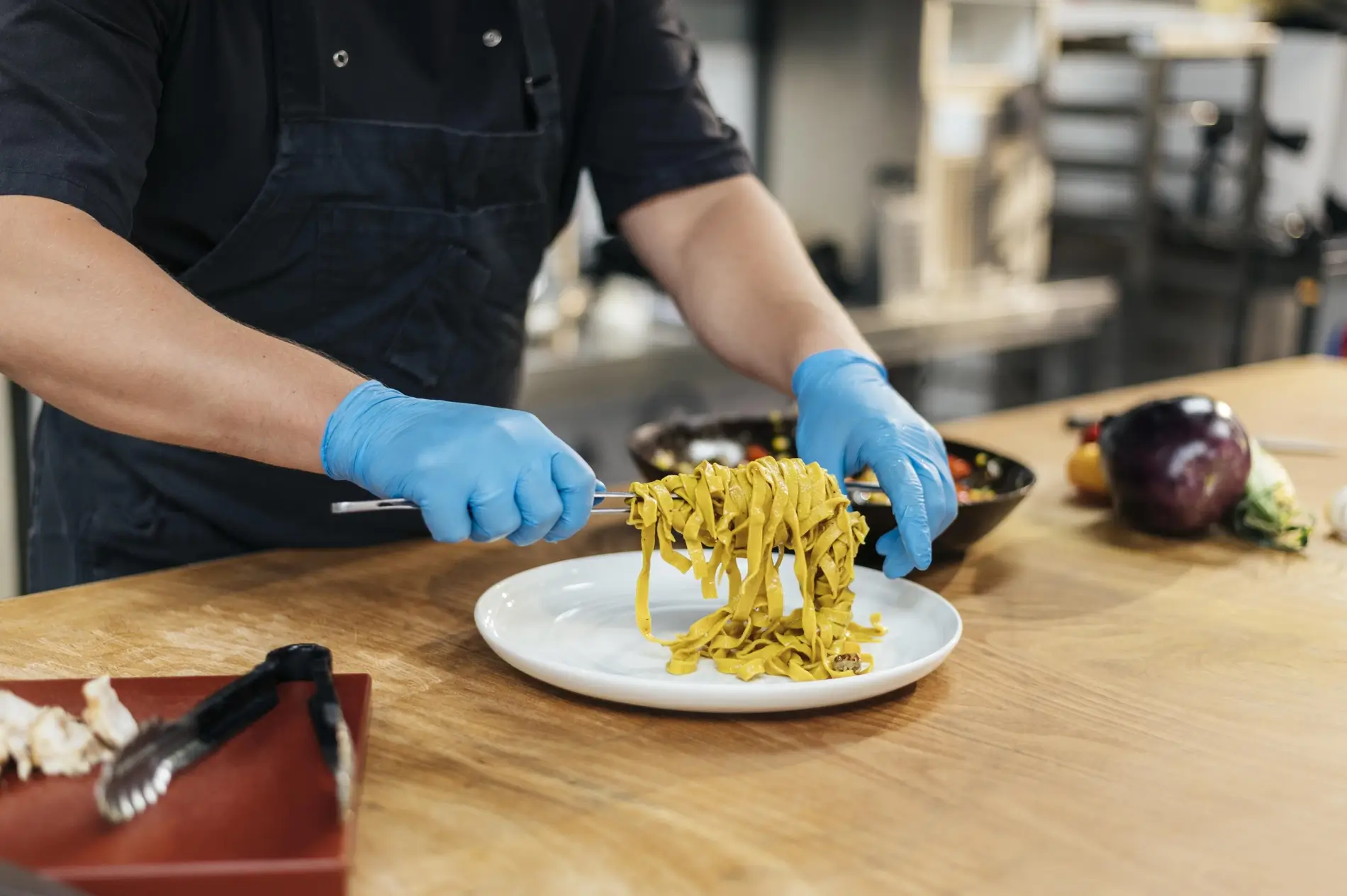
In food handling environments, gloves are essential as they represent a safety barrier between operators and products. Their role goes far beyond basic hygiene: they prevent contamination, protect food integrity, and ensure compliance with safety standards throughout the entire food preparation process.
In practical terms, appropriate food-grade gloves reduce the risk of cross-contamination, limit direct contact with potentially harmful substances, and protect operators’ hands from prolonged exposure to moisture, fats, acids, and other food-related agents. They are also designed to ensure comfort, dexterity, and durability in professional settings where tasks are rapid and repetitive.
The selection of work gloves is also a regulatory matter. Gloves intended for food contact must comply with specific requirements set out in European MOCA regulations, ensuring that they do not release harmful substances or alter the organoleptic properties of food.
Finally, material selection is crucial. Among disposable options, nitrile and vinyl gloves are the most widely used in the food sector; however, their performance, durability, and food compatibility differ significantly. Let us examine them in detail.
Food Gloves and Regulatory Compliance
Not all disposable gloves provide the same level of safety or suitability for different food categories.
Disposable gloves used in food handling fall within the category of Materials and Articles in Contact with Food (MOCA). This means they must be designed and manufactured to prevent the transfer of substances to food in quantities that could endanger human health or modify the food’s organoleptic characteristics.
MOCA compliance ensures that the glove acts as a safe barrier under various conditions of use and with different types of food, regardless of the material from which it is made.
Suitability for Food Contact and the Glass & Fork Symbol
Gloves suitable for food contact are identified by the glass and fork symbol, confirming that the product has been tested and evaluated for food use. The symbol must be supported by appropriate technical documentation (typically a Declaration of Conformity) specifying:
-
The material
-
The food categories for which the glove is suitable
-
Any limitations or restrictions of use (for example, exclusion of fatty or alcoholic foods)
This information is essential in professional environments where gloves come into daily contact with different food matrices.
Regulatory Framework for Food Contact Gloves
In Europe, gloves intended for food contact are primarily regulated by:
-
Regulation (EC) No 1935/2004, which establishes the general safety principles for materials intended to come into contact with food.
-
Regulation (EU) No 10/2011, specifically concerning plastic materials and articles, including PVC-based gloves such as vinyl.
These regulations define migration limits, testing conditions, and safety criteria.
The Importance of Global Migration Testing
Global migration testing measures the total quantity of substances that may migrate from the glove to food under standardized conditions of time, temperature, and food simulants.
Testing reproduces worst-case scenarios for different categories: aqueous, acidic, alcoholic, dairy, fatty, and dry foods. Passing these tests confirms that the glove maintains its integrity and does not release substances beyond legal limits.
For food sector operators, migration testing represents a concrete guarantee of safety, particularly when handling complex or high-risk foods.
What Are Nitrile Gloves Made Of?
Nitrile gloves are made of NBR (Nitrile Butadiene Rubber), a synthetic rubber obtained from the combination of acrylonitrile and butadiene. Originally developed as an alternative to latex, NBR provides high resistance and chemical stability without the allergy risk typically associated with natural latex.
Its molecular structure ensures an optimal balance between elasticity, mechanical strength, and protection, making nitrile one of the most reliable materials for disposable gloves intended for demanding applications, including food handling.
What Are Vinyl Gloves Made Of?
Vinyl gloves are made of polyvinyl chloride (PVC), a rigid plastic polymer that requires plasticizers—commonly DINP (phthalates)—to achieve the softness and flexibility necessary for glove use.
Plasticizers are not chemically bound to the PVC polymer matrix. This means they may migrate over time, particularly when in contact with fats, oils, or alcohol. This migration potential is especially relevant in food contact applications and directly affects the declared scope of use of the glove.
If used outside their certified compatibility – particularly with fatty or oily foods – vinyl gloves may present a higher migration risk. For this reason, they are generally intended for short-duration, low-risk applications with limited mechanical stress and clearly defined food compatibility.
Nitrile vs. Vinyl Gloves: Key Differences
Although both are widely used in food handling, the actual performance of nitrile and vinyl work gloves differs significantly. The differences are particularly evident in mechanical behavior, barrier effectiveness, and suitability for various usage scenarios.
Mechanical Strength and Elasticity
Nitrile gloves are naturally elastic: they adapt to the hand and return to their original shape without permanent deformation. This ensures high tear resistance even during repetitive movements or under pressure.
Vinyl, by contrast, has limited elasticity. The material tends to deform rather than stretch, increasing the risk of tearing even under light stress. This lower elasticity also affects tactile sensitivity, as vinyl adheres less closely to the hand, reducing precision in detailed tasks.
Under pressure, nitrile maintains its structural integrity, whereas vinyl is more prone to thinning, stress marks, and micro-tears.
Barrier Protection and Porosity
Nitrile and vinyl gloves provide a protective barrier with an AQL 1.5 for pinholes.
Over time and under stress, nitrile maintains consistent performance, whereas vinyl may degrade more rapidly, particularly when in contact with fatty foods or under repeated mechanical strain.
Durability and Intended Use
Durability directly affects how work gloves should be used.
Nitrile gloves are designed for extended use within the same task, as they maintain performance and fit even during prolonged sessions. Their resistance makes them suitable for higher-risk contexts, including extended food contact, humid environments, or specific raw materials.
Vinyl gloves are suitable for short, low-risk applications with limited exposure and minimal mechanical stress. As explained earlier, prolonged use increases the risk of material degradation.
In summary, nitrile offers a greater safety margin and versatility, while vinyl requires careful evaluation of duration and risk level.
Which Gloves Are Most Suitable for Fatty and Oily Foods?
For handling fatty or oily foods, nitrile gloves are unquestionably the safer choice. The material maintains structural integrity during prolonged contact with oils and fats: it does not soften, swell, or degrade when exposed to lipids, confirming its stability as a protective barrier.
The chemical stability of nitrile presents a low risk of substance migration into fatty foods. This is critical because fats and oils act as powerful solvents, increasing the likelihood that additives or processing residues may migrate from glove materials into food.
Vinyl gloves rely on plasticizers for flexibility, and these substances may migrate more easily into fatty foods, potentially exceeding acceptable limits if the gloves are not specifically certified for such use. This characteristic significantly limits the suitability of vinyl gloves for handling high-fat foods.
When Can Vinyl Gloves Be Used in Food Handling?
Vinyl gloves may be used in food handling only within a clearly defined and tested scope of application. If properly tested and declared compliant, they may be suitable for dry or acidic foods, typically with short contact times.
They are generally recommended for simple, low-risk tasks with minimal mechanical stress and limited exposure to food substances. In such contexts, they can ensure an acceptable hygienic level, provided they are frequently replaced and used according to the manufacturer’s instructions.
However, compared to nitrile, vinyl offers a narrower spectrum of food compatibility and is often excluded from contact with fatty, oily, alcoholic, or certain dairy foods.
For operators handling multiple food categories throughout the day or working in dynamic environments, this limited scope increases the risk of improper use. In such cases, gloves with broader compatibility – such as food-grade nitrile gloves – consistently prove to be a safer and more practical solution.
Reflexx Food Line: Gloves Designed for Safe Food Handling
Reflexx Food Line has been developed to provide a reliable solution for professionals who handle food daily and require gloves with a broad and clearly defined scope of use.
All gloves in the Food Line range are specifically designed for food contact and comply with MOCA requirements, ensuring they do not release substances that could compromise food safety or organoleptic properties. The line is primarily based on powder-free nitrile gloves, selected for their chemical stability, mechanical strength, and reduced migration risk, even with fatty and oily foods.
Each product undergoes periodic testing at accredited laboratories, including global and specific migration tests conducted under standardized conditions simulating real and foreseeable usage scenarios. This approach ensures continuous material performance monitoring and a high level of safety throughout the product lifecycle.
By offering tested, technically documented work gloves suitable for a wide range of food applications, Reflexx simplifies operators’ selection process and supports hygiene, safety, and regulatory compliance in professional environments.
Contact our experts for dedicated advice.