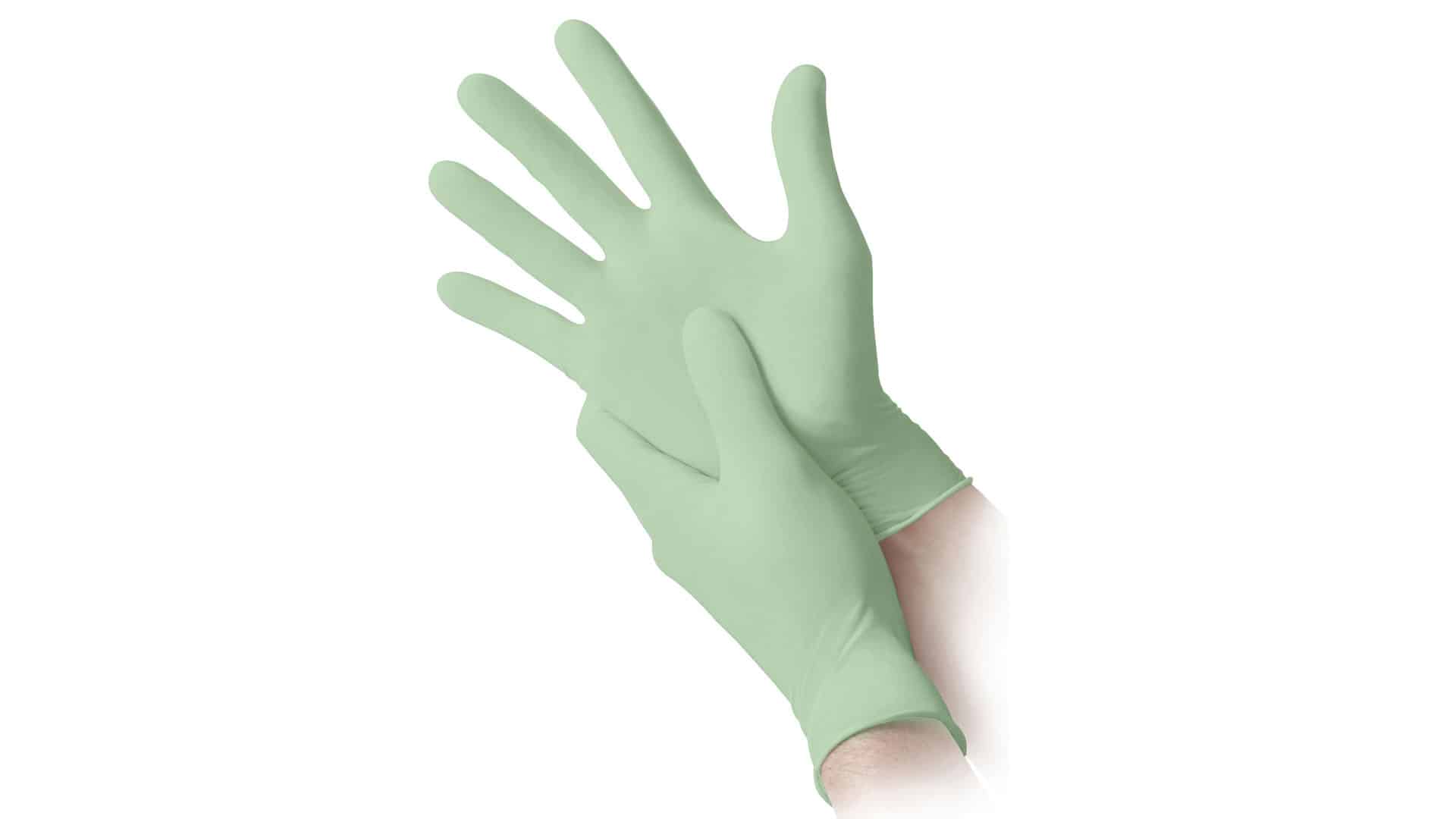


Surface: Microrough
Lenght cm: 24
Thickness mm: 0.07
Weight g: 3.5 – size M +/- 0.2
Colour: Pastel Green
Other features: Inner chlorination
REFLEXX NBio” NITRILE GLOVES: How do they work?
Nitrile gloves produced contain additives that accelerate the biodegradation process under anaerobic conditions, when disposed of in biologically active landfills, due to the action of naturally occurring microorganisms.
Anaerobic biodegradation typically occurs in marine sediments and landfills. The rate of biodegradation depends on environmental conditions and can vary according to temperature, humidity, and the microbial load present in each landfill. The additives speed up the biodegradation process of nitrile rubber gloves.
Biodegradation additives allow the nitrile rubber polymers to be more easily broken down into simpler and smaller molecules (oligomers, dimers, and monomers) through hydrolysis and oxidation reactions by microbial enzymes (lipases, proteinases, hydrogenases). During this degradation process, microbial exoenzymes break the bonds of the polymer chains, leading to the formation of small molecules and oligomers capable of passing through the outer membrane of bacteria and being used as a carbon source and/or energy source by bacterial cells.
This results in the decomposition into simple inorganic compounds, with the release of biogas (CO₂ under aerobic conditions; CH₄ under anaerobic conditions), biomass, water (H₂O), and inorganic residues (if present in the original material).
The glove material undergoes fragmentation and mineralization, losing its initial structure. It does not break down into microplastics because it does not undergo physical oxo-degradation processes.
These gloves have been tested according to ASTM-D5511-18 standards (“Standard Test Method for determining the anaerobic biodegradation of plastic materials under high-solids anaerobic-digestion conditions”), a test that simulates anaerobic biodegradation in an active landfill.

The results of the laboratory analyses carried out on the product “REFLEXX NBio” show effective biodegradation under the conditions specified by the test method, with results of around 76% w/w after 660 days, whereas standard nitrile gloves show a value of approximately 1.17%.
In addition to the tests based on the aforementioned ASTM methods, further analyses were conducted to determine the Biochemical Methane Potential (BMP), a parameter used to measure the maximum methane yield produced by microorganisms from organic substrates, thereby providing an indication of biodegradability.
EVERY PRODUCT BIODEGRADES AND DISSOLVES IN THE ENVIRONMENT, BUT SOME PRODUCTS MAY TAKE DECADES OR EVEN HUNDREDS OF YEARS, WHILE OTHERS CAN DO SO MORE QUICKLY DEPENDING ON THEIR NATURE, CHEMICAL-PHYSICAL CHARACTERISTICS, AND/OR THANKS TO THE APPLICATION OF NEW BIODEGRADATION TECHNOLOGIES.
IN ANY CASE, BIODEGRADATION REQUIRES A LONG TIME, WHICH IS WHY NO PRODUCT SHOULD BE DISPOSED OF IN THE ENVIRONMENT.