
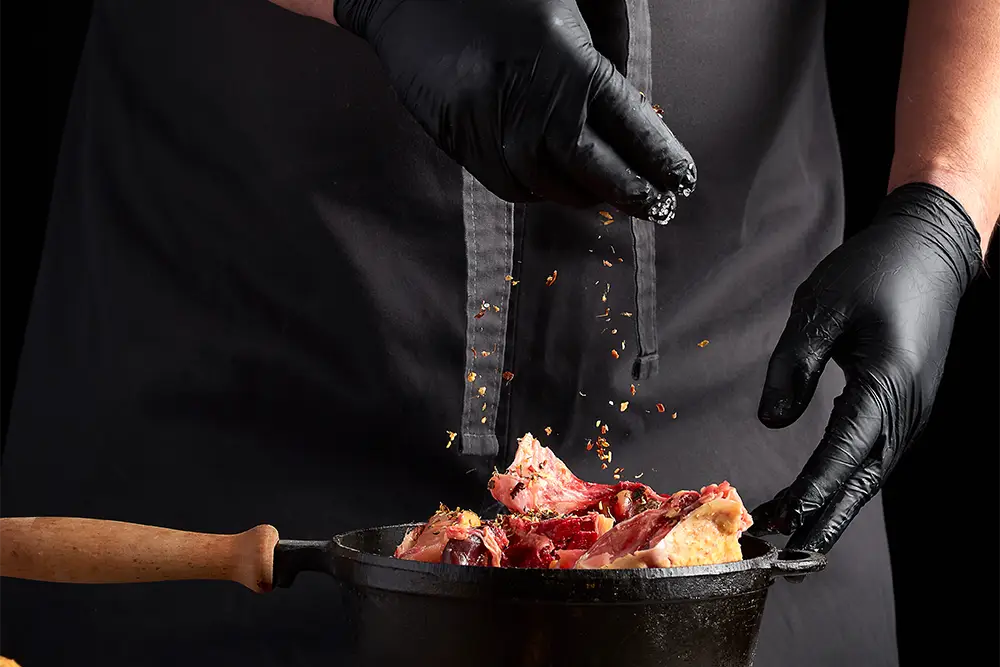
Gloves intended for food contact are PPE designed to maintain safety and hygiene at every stage of the food supply chain. To meet these requirements, gloves must be tested in compliance with current regulations, with specific tests depending on the category of food to be handled and the conditions of use in terms of time and temperature.
Reflexx meets these needs with a range of dedicated gloves, developed to offer resistance, stability, and full compliance with European regulations, ensuring high performance in every professional context.
Why is specific protection needed for fatty foods?
Fatty or oily foods include all ingredients or food preparations characterized by a significant lipid content. Common examples include butter and margarine, soft cheeses or cheeses preserved in oil, spreadable creams, processed meats, high-fat baked goods, emulsified sauces such as mayonnaise and pesto, and others.
If gloves that are not suitable for handling fatty foods are used, migration of molecules or chemical substances into the food may occur. This results in a concrete risk to food safety, with possible alterations to the organoleptic characteristics of the product and, in the worst cases, even harmful effects on consumer health.
To prevent these issues, it is therefore essential to use gloves that have been specifically tested to provide a stable protective barrier in the presence of lipid substances.
Which materials are suitable for contact with oily or fatty foods?
Material selection is a determining factor when working with foods rich in fats.
Fats and oils can interact with the components of unsuitable gloves, altering their structure and promoting the release of unwanted substances. For this reason, not all materials commonly used in professional disposable gloves can guarantee the safety and compliance required in the food sector.
Nitrile: the safest choice
Among all materials used in the production of disposable gloves, nitrile offers the best guarantees for handling fatty or oily foods. It is a synthetic, latex-free rubber that is stable and intrinsically resistant to the solvent action of lipids.
Nitrile:
-
Maintains its structural integrity even after prolonged contact with oils and fats.
-
Significantly reduces the risk of chemical migration. Results from global and specific migration tests comply with the requirements set out by MOCA regulations for food contact.
These characteristics make nitrile the most reliable solution for professional kitchens, food laboratories, the Ho.Re.Ca. industry, and, more generally, for all activities requiring contact with food.
Latex and vinyl: limitations and risks
Although they offer comfort and good tactile sensitivity, latex gloves are not considered the best option for handling fatty foods. Natural rubber tends to degrade when in contact with fatty substances, and migration test results often fail to meet the requirements set by MOCA regulations. In this case, it is more appropriate to speak of migration rather than protection.
Vinyl gloves pose an even greater risk: they contain plasticizers which, in the presence of oily foods, can migrate in quantities exceeding the permitted limits, compromising product safety and violating regulations governing materials intended for food contact.
In summary, only food-tested nitrile gloves guarantee the most effective combination of safety, stability, and regulatory compliance. For all applications involving direct contact with fatty substances, they represent the best choice.
MOCA compliance: what does it mean?
The term MOCA (Materials and Articles in Contact with Food) refers to all products intended to come into direct or indirect contact with food, including disposable food gloves. To be considered suitable, these materials must comply with a fundamental principle: they must not transfer hazardous substances to food nor alter its organoleptic characteristics (odor, taste, color, texture).
The regulatory basis is Regulation (EC) 1935/2004, which establishes the so-called Good Manufacturing Practices to ensure consistent quality and safety in production processes.
Subsequent regulatory updates include:
-
(EC) 2023/2006: update of the Good Manufacturing Practices.
-
(EU) 10/2011: defines composition, migration limits, and permitted substances for plastic materials intended for food contact.
-
Ministerial Decree 21/03/1973: the Italian regulation that still governs materials not covered by the more recent European regulation and remains relevant at national level for rubbers, and therefore for nitrile and latex gloves.
To be declared compliant for all food categories, a glove must pass all tests required by the regulations, carried out by qualified laboratories.
Reflexx conducts global and specific migration tests at accredited laboratories. Rigorous controls ensure that Reflexx professional gloves provide safety, quality, and full regulatory compliance at every stage of food handling.
When can a glove be considered suitable for oily or fatty foods?
A professional glove can be considered suitable for contact with oily and fatty foods when it passes global and specific migration tests using vegetable oil as the simulant.
If the material is not adequate, fats and oils can promote the migration into vegetable oil of plasticizers (phthalates) or other chemical substances, exceeding the limits permitted by European regulations and posing a concrete risk to consumer health.
For product safety and consumer protection, it is the manufacturer’s responsibility to indicate the exclusion of one or more food categories in the event of non-compliant test results.
For this reason, when handling fatty foods, it is essential to use MOCA-certified nitrile gloves, tested to ensure stability, resistance, and total neutrality during contact with the most critical food categories.
Reflexx gloves for handling oily or fatty foods
Reflexx offers a range of disposable food gloves designed to ensure safety, comfort, and full compliance with European regulations. Each model is developed using selected materials and subjected to rigorous MOCA testing, ensuring resistance, stability, and protection even when in contact with particularly critical foods, such as fatty or oily products.
Reflexx 77 Food Line nitrile gloves
Reflexx 77 Food Line gloves are made of powder-free nitrile, with a thickness of 3.0 g (size M), ensuring an optimal balance between lightness and resistance. They are ultra-thin gloves designed to provide high tactile sensitivity without compromising protection during food handling.
Key features include:
-
Latex-free, making them ideal for operators with latex allergies.
-
Full MOCA compliance, for safe use with all food categories.
-
Micro-textured fingertips for a secure and controlled grip.
-
Completely powder-free.
These construction qualities make them a versatile solution for professional kitchens, food laboratories, and preparation areas with high-frequency activities.
Reflexx 72 Food Line nitrile gloves
Reflexx 72 Food Line gloves are among the most appreciated professional disposable gloves in the Ho.Re.Ca. sector and the food industry. Made of powder-free nitrile with a thickness of 3.5 g (size M), they are specifically designed for contact with all foods, including oily or fatty ones.
Main strengths include:
-
Full MOCA compliance, for safe use with all food categories.
-
Stable formulation tested for 30 minutes at 40°C.
-
Excellent resistance to oils and fats, ideal for intensive processing.
-
Completely latex-free and powder-free, ensuring prolonged comfort.
The combination of sensitivity, grip, and robustness makes them a reliable choice for chefs, food processing staff, and catering professionals.
Reflexx T22 Thermoplastic Elastomer (TPE) gloves
Reflexx T22 gloves are made of TPE (thermoplastic elastomers), a lightweight, versatile, and extremely reliable material.
Key distinguishing features include:
-
Embossed surface to improve grip and safety during operations.
-
Increased thickness and quick donning, ideal for frequent, short-duration tasks.
-
Can also be used as an over-glove.
-
Silicone-free, ensuring compatibility with sensitive foods and equipment.
-
Disposable, ambidextrous, and compliant with food contact requirements.
SUITABLE FOR CONTACT OF UP TO 2 HOURS WITH ALL FOODS
Thanks to their practicality, they are particularly suitable for packaging departments, fast processing tasks, and food-related environments where gloves need to be changed multiple times during operations.
How to choose the right food glove
To ensure safety and compliance, it is essential to always check for the presence of the appropriate symbol (insert pictogram), which certifies that the glove is suitable for food contact according to MOCA regulations.
The choice of the most appropriate glove depends on the type of food being handled.
Fatty or oily foods, acidic foods, alcoholic preparations, or aqueous foods have different extraction powers on glove materials.
The physical characteristics of the glove also influence the choice: thickness, elasticity, and tactile sensitivity determine comfort and effectiveness in different tasks, from quick preparation to work requiring greater precision. When operators are exposed to prolonged contact with fats and oils, disposable nitrile food gloves prove to be the safest solution, as they maintain stability and do not release unwanted substances into food.
In addition to marking, it is essential that the product has passed global and specific migration tests, ensuring that the glove will not alter either the composition or the sensory characteristics of the foods it comes into contact with. This allows work to be carried out continuously and safely, while fully complying with European regulations.
The color of the glove should also be considered, as it plays a fundamental practical role in the food sector. Although there is no legislation requiring the use of blue gloves, this color is generally preferred because it is rarely present in foods and is therefore easily identifiable if fragments are accidentally dispersed along the production line. Many companies also use detection systems or spectrograms calibrated specifically for blue to quickly identify any visual contamination.
To work with maximum safety and compliance, discover the full range of Reflexx gloves and choose the solution best suited to your activity.